Tanzania holds one of the biggest bird lists in Africa, with more than 1,100 recorded species inside its borders. Birders find roughly 800 residents, close to 200 regular migrants, and a small group of endemics found nowhere else, spread across the parks and islands. That variety comes from the range of habitats, from savanna and soda lakes to mountain forest and coastal woodland.
For anyone planning a trip, the good news is that birds are everywhere in Tanzania, not tucked away in one reserve. A general safari through the north will hand you several hundred species without any special effort, while a dedicated birding route can push a two-week list well past 400 or 500. This guide walks through what makes the birdlife here so rich, which birds are worth chasing, and where and when to look.
Why Tanzania Holds Over 1,100 Bird Species
The number sounds almost unreal until you look at the map. Tanzania sits where several major African habitat zones meet, and each zone brings its own set of birds. The Serengeti and Maasai plains carry the classic dry-country savanna species. The Great Rift Valley cuts through with its chain of soda and freshwater lakes, drawing waterbirds by the tens of thousands. The Eastern Arc Mountains, a scatter of old forested ranges near the coast, act like green islands that have grown their own specialities over millions of years. Then there is the Indian Ocean coast and the islands of Pemba and Zanzibar, which add species with a distinctly coastal and forest character.
This variety is why a single country can hold soda-lake flamingos, plains ostriches, forest partridges, sunbirds, and deep-water seabirds all at once. No other combination in East Africa quite matches it. The country also sits on a major flyway, so on top of the residents you get a heavy pulse of visitors each year from Europe and Asia, plus birds that move around within Africa itself following the rains.
Habitat shapes the list. If you want the highest species count, plan a route that touches at least three habitat types: savanna, a Rift Valley lake, and one patch of forest. Each one adds a block of birds the others will never give you.
The Endemic Birds of Tanzania
The birds that pull serious birders across the world are the endemics, the species restricted to Tanzania and often to a single mountain range. Most of them live in the Eastern Arc Mountains, which many rate as the most important birding region in the country. These forests are cool, damp, and old, and they have held their bird populations in isolation long enough for new species to form.
The Udzungwa forest partridge is the headline bird. It was only described by science in 1991, a brownish partridge with a rufous face and red bill that skulks through dense forest floor in the Udzungwa Mountains. It is genuinely hard to see, and honest birders will tell you that a clear look is never guaranteed. The same forests hold the rufous-winged sunbird and the Iringa akalat, both tied closely to the Eastern Arc.
Further north, the Usambara Mountains and the Amani Nature Reserve carry their own set. The Usambara eagle-owl, the long-billed tailorbird, and the Usambara violet-backed sunbird are all sought after, and the elusive African green broadbill turns up here too. These are small, quiet forest birds, and finding them usually means slow walks with a guide who knows the calls.
Out on Pemba Island, four species have evolved in isolation: the Pemba green pigeon, the Pemba scops owl, the Pemba sunbird, and the Pemba white-eye. A short trip to the island can clean up all four in a day or two, which is why Pemba features on almost every dedicated Tanzania bird tour. The northern safari circuit adds a few easier endemics and near-endemics too, including the ashy starling, the grey-breasted spurfowl, and the yellow-collared and Fischer’s lovebirds, all of which you can meet on a normal game drive.
Flamingos and the Rift Valley Soda Lakes
Few bird sights in Africa match a soda lake rimmed in pink. The Rift Valley lakes of northern Tanzania run heavy with natural soda and salt, which feeds blooms of algae that lesser flamingos filter by the million. Lake Natron is the centre of it all. It is the single most important breeding site on earth for the lesser flamingo, and at peak times two to four million birds gather on its soda flats. Something close to 75 percent of the world population is born here, on mud nest mounds set out in caustic water that keeps predators away.
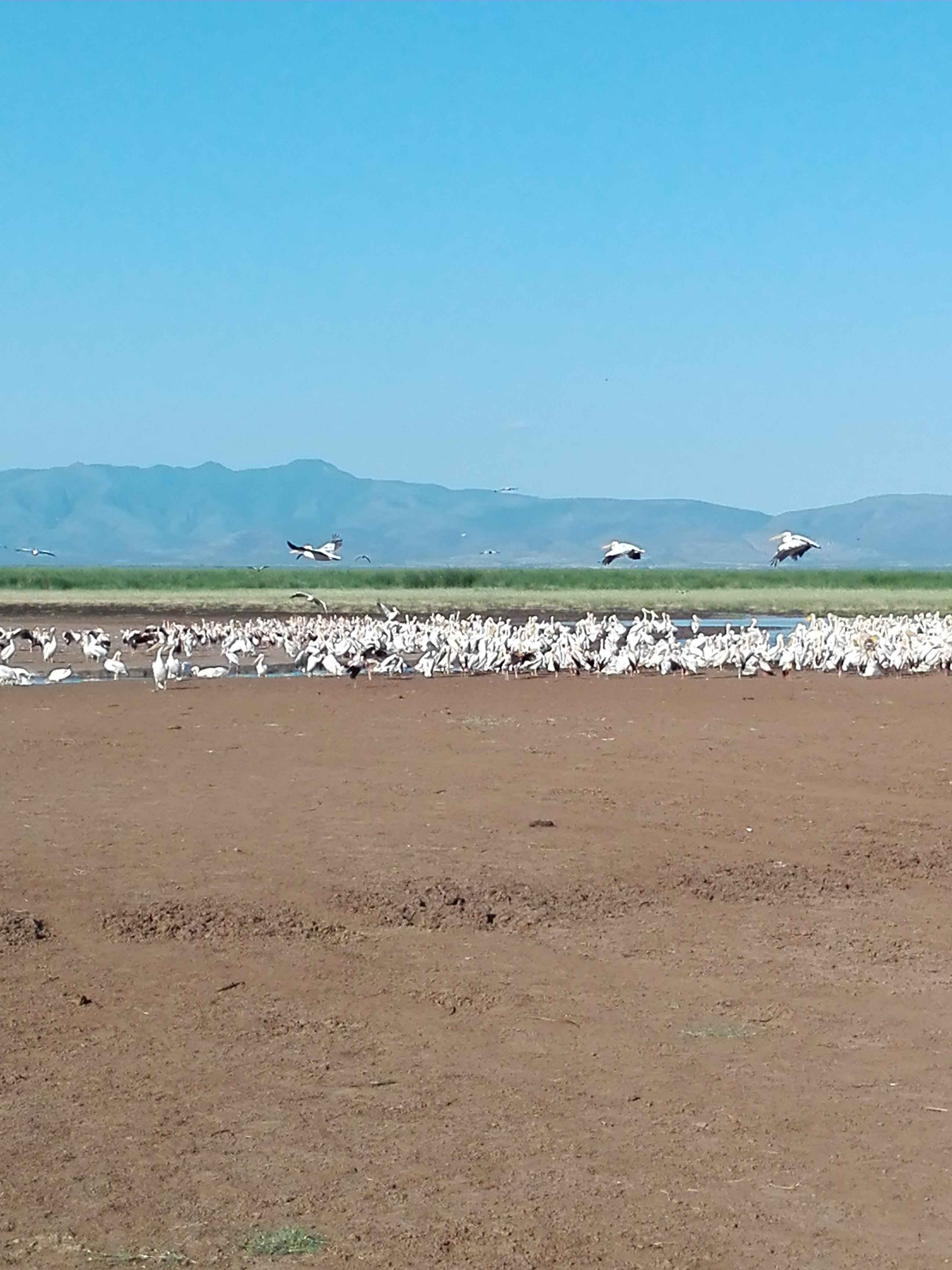
Natron is a harsh place to visit and access is limited, but the reward is a spectacle you will not forget. Most breeding runs from around September to December, and once the chicks are grown the flocks drift to other lakes. Nearby Lake Manyara often carries its own pink band along the shore, and it is far easier to reach as part of a standard safari. Beyond flamingos, these lakes and their margins pull in pelicans, storks, waders, and ducks, so the birding stays busy even when the flamingo numbers dip. Water levels shift the birds around from year to year, so it pays to ask locally where the flocks are sitting before you go.
Two to four million lesser flamingos on one lake is not a number you read. It is a wall of colour and sound that changes how you think about birds.
Raptors, Ostriches, and the Savanna Birds
The open plains give you the big, obvious birds that even non-birders love. The common ostrich strides across the Serengeti and Ngorongoro grasslands, the tallest and heaviest bird alive, and the kori bustard shares the same open ground as one of the heaviest flying birds. Both are easy to pick out simply because of their size, which makes them a gentle entry point for anyone new to birds.
Raptors are a real strength of the savanna. Lake Manyara alone has recorded around 50 species of birds of prey, from the palm-nut vulture to Ayres’s hawk-eagle. On the plains you can watch martial eagles, bateleurs, brown snake-eagles, and the ground-walking secretary bird as it hunts snakes on foot. Tarangire, with its baobabs and seasonal swamps, is especially good for eagles and owls, including Verreaux’s eagle-owl. Add rollers, bee-eaters, hornbills, starlings, and weavers, and the savanna delivers a steady stream of colour between the big mammals.
The Best Birding Areas on a Tanzania Safari
Northern Tanzania is where most visitors start, because the classic wildlife parks are also excellent for birds. The birds of Lake Manyara make it one of the finest compact sites in the country. The park proper holds about 400 species and the wider biosphere reserve nears 600, and a sharp-eyed visitor can log over 100 species in a single day between the groundwater forest, the lakeshore, and the acacia woodland.
Arusha National Park packs an incredible spread of habitats into a small area and returns around 400 species. Tarangire runs a list beyond 500, helped by its swamps and old baobabs. On the Serengeti, the plains carry over 500 species too, with the kori bustard, secretary bird, and a strong cast of raptors set against the open grassland. Together these parks make the northern circuit a place where big game and big bird lists come in the same drive.
For the true specialities you head to the forests. The Udzungwa Mountains in the south are a biodiversity hotspot and the home of the forest partridge, the rufous-winged sunbird, and the Iringa akalat. The Usambara and Uluguru ranges hold more Eastern Arc endemics, and Pemba Island offers its four island specials. A birder chasing the full national list usually pairs the northern savanna with a forest leg and, if time allows, the island.
Lake Manyara: compact, around 400 species, flamingos and 50-plus raptors, over 100 species possible in a day.
Serengeti: 500-plus species, ostrich, kori bustard, secretary bird, and open-country raptors alongside the big cats.
Tarangire: 500-plus species, baobab and swamp birds, ashy starling and yellow-collared lovebird, strong on eagles and owls.
Udzungwa Mountains: Eastern Arc forest, the forest partridge and other endemics for the dedicated birder.
Pemba Island: four island endemics in coastal forest, a short but rewarding add-on.
The Best Time for a Tanzania Birding Tour
Birds are good in Tanzania all year, but the birding peaks from November to April. That is when the Palearctic migrants from Europe and Asia arrive, joined by intra-African migrants that follow the rains. During these months many resident birds also slip into breeding plumage and start calling and displaying, which makes them easier to find and identify. The wet season brings the fullest lists of the year.
The trade-off is weather. The rains that bring the migrants also bring mud and the odd washed-out road, and some forest tracks get harder to travel. The drier months from June to October are more comfortable and better for general game viewing, and the resident birds are still very much present, so a dry-season safari will never leave you short of birds. If your main aim is the highest possible species count, aim for the green months. If you want a balance of birds and easy travel, the shoulder of the seasons works well.
How Birding Pairs With a Tanzania Safari
One of the best things about birding here is that you rarely have to choose between birds and mammals. Many of the top birding sites are the same reserves people visit for lions and elephants, so a general Tanzania safari doubles as a birding trip whether you plan it that way or not. On a single game drive you might watch a leopard in a sausage tree while lilac-breasted rollers and superb starlings work the roadside, then reach a lake edge lined with flamingos and pelicans.
4-Day Ngorongoro, Tarangire & Lake Manyara Explorer
3 Days Lake Manyara & Tarangire
6-Day Arusha, Manyara, Tarangire & Ngorongoro Safari
If birds are your priority, a specialist guide changes the trip completely. A good bird guide knows the calls, the display sites, and the seasonal movements, and can turn a decent day list into a great one. Many operators run mixed trips that build in extra time at wetlands, forest edges, and lake shores while still covering the famous mammals. This blend, top-level African birding sitting right next to some of the finest big-game watching on the continent, is exactly why so many birders put Tanzania at the top of their list. You do not sacrifice the safari to chase birds, and you do not miss the birds to see the game.
Whether you come for the flamingo lakes, the forest endemics, or simply the constant flow of colour beside the mammals, Tanzania rewards anyone who looks up. Bring binoculars and a field guide, and even a standard safari turns into a bird trip worth remembering.
Frequently Asked Questions About Tanzania Birds
How many bird species are there in Tanzania?
More than 1,100 species have been recorded, and the confirmed total is now around 1,160. That includes roughly 800 residents, close to 200 regular migrants, and near 30 to 40 species found only in Tanzania. It is one of the largest bird lists of any African country.
What are the endemic birds of Tanzania?
The best known are the Udzungwa forest partridge, the rufous-winged sunbird, and the Iringa akalat of the Udzungwa Mountains, several Usambara birds such as the long-billed tailorbird and Usambara eagle-owl, and the four Pemba Island specials, the Pemba green pigeon, scops owl, sunbird, and white-eye. Most live in the Eastern Arc Mountains.
When is the best time for birding in Tanzania?
November to April is the peak, when Palearctic and intra-African migrants arrive and many resident birds are in breeding plumage. The drier months from June to October are easier for travel and still very good for resident birds and general game viewing.
Where can I see flamingos in Tanzania?
Lake Natron is the main breeding site for lesser flamingos and can hold two to four million birds, though access is limited. Lake Manyara is far easier to reach on a standard safari and often carries a pink band of flamingos along its shore. Water levels move the flocks around, so check locally before you travel.
Can I combine birding with a normal safari?
Yes, and most people do. The famous wildlife parks such as Lake Manyara, the Serengeti, and Tarangire are also excellent for birds, so a general safari builds a strong bird list on its own. Adding a specialist bird guide and some time at wetlands and forests turns it into a full birding trip.
How much does a Tanzania birding trip cost?
Costs vary widely with length, comfort level, and how remote your route is. A shared mid-range birding safari on the northern circuit tends to fall in the low hundreds of US dollars per person per day, covering guide, vehicle, park fees, and lodging. Dedicated tours that add forest legs and Pemba Island, or that use a specialist bird guide and private vehicle, run higher. Ask operators for a clear breakdown of park fees, guiding, and accommodation before you book.